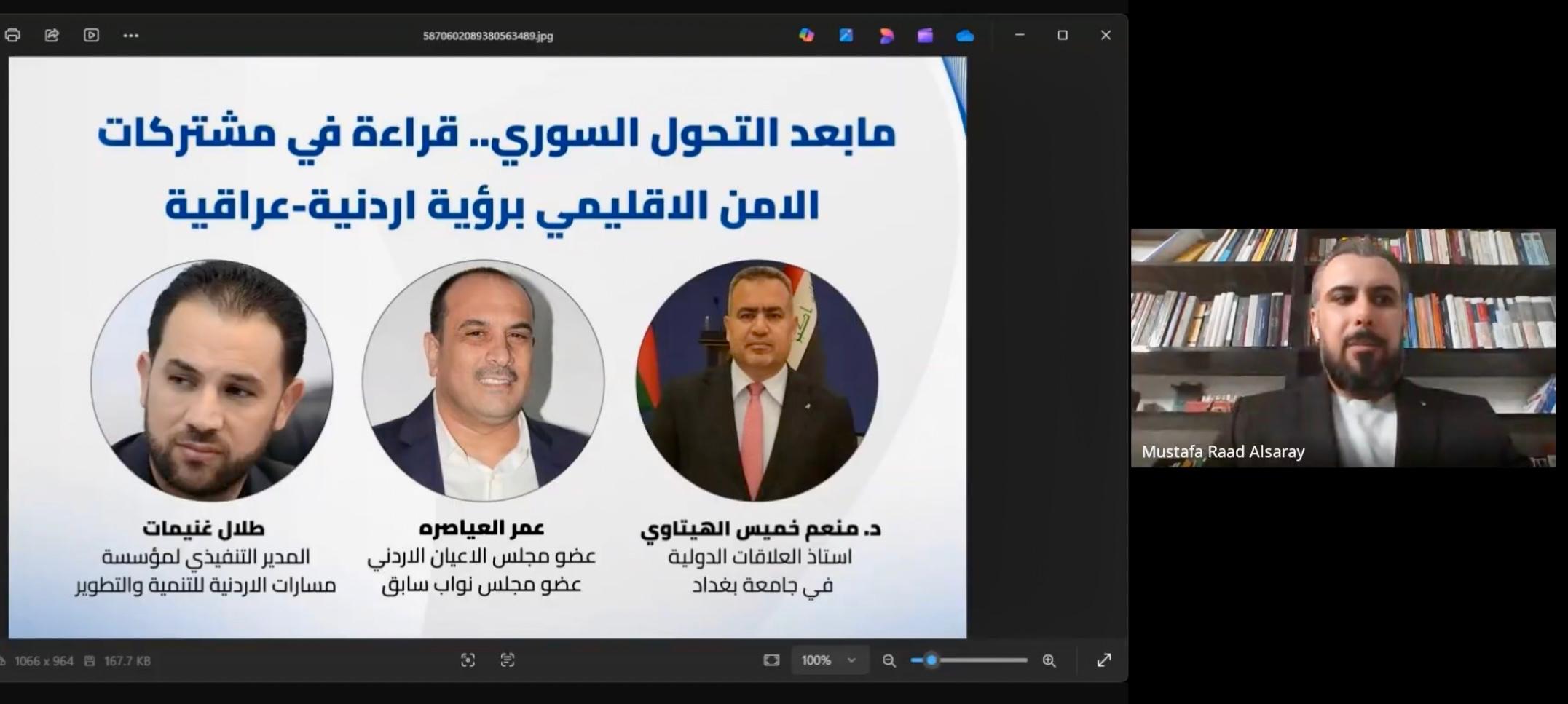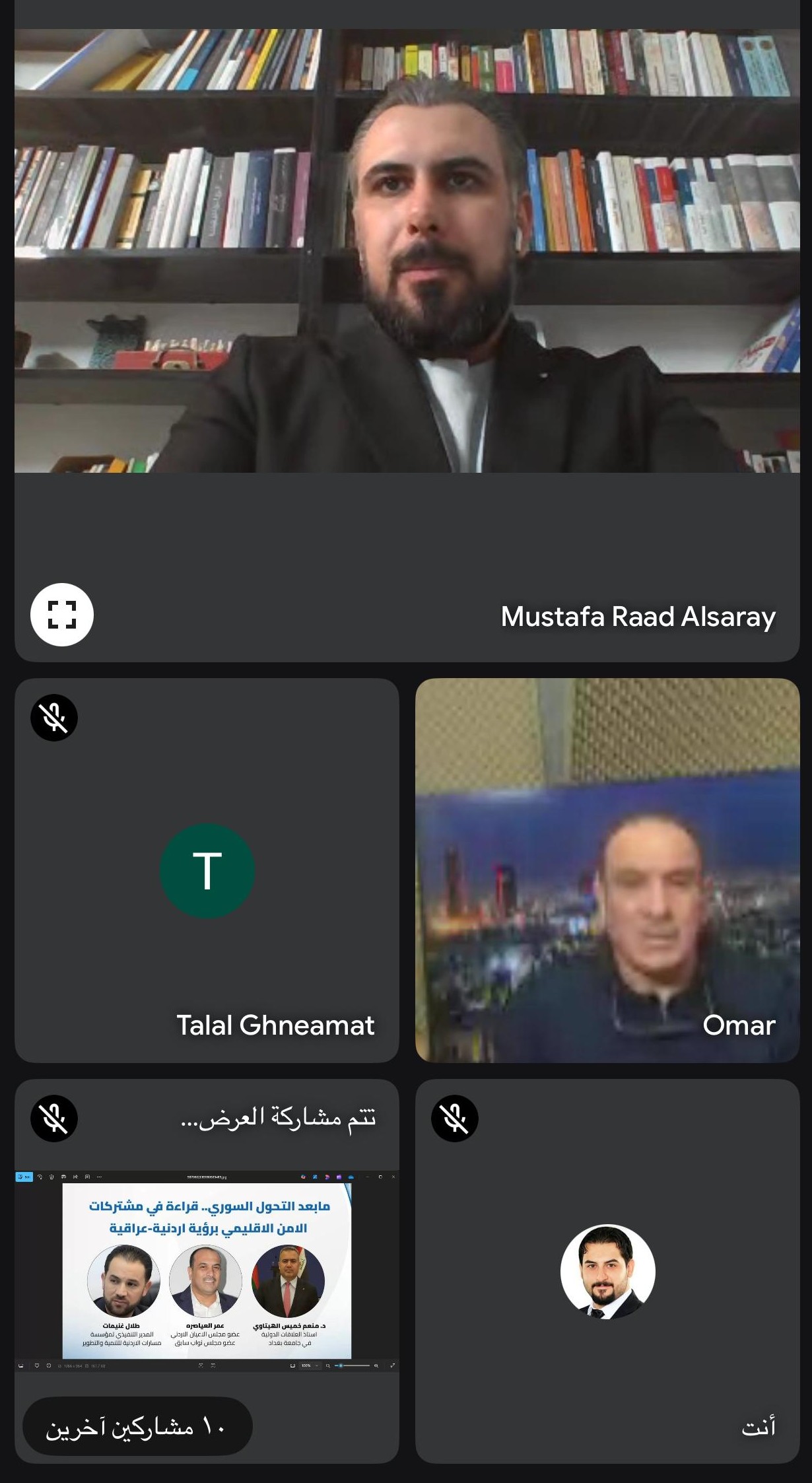

The Al-Bayan Center for Studies and Planning convened an online dialogue session entitled “Post-Syrian Transition: A Reading in Shared Aspects of Regional Security from a Jordanian–Iraqi Perspective.” The session brought together a select group of experts and decision-makers from Iraq and Jordan to discuss developments in the Syrian dossier and their implications for regional security.
The session featured contributions from:
- Omar Al-Ayasrah, Member of the Jordanian Senate and former Member of Parliament.
- Talal Ghoneimat, Executive Director of the Jordanian Masarat Foundation for Development and Advancement.
- Dr. Munaem Khamees Al-Haytawi, Professor of International Relations at the University of Baghdad.
During the session, the participants emphasized that Jordan maintains a clear position toward Damascus, centered on the necessity of reintegrating Syria into its Arab sphere. They also pointed to Jordanian concerns regarding Israeli conduct toward Syria, particularly in relation to the so-called “David’s Corridor,” Israel’s attempts to present itself as the protector of Syrian minorities—especially the Druze—as well as its repeated violations of Syrian land and airspace.
The Jordanian side stressed that Damascus must resolve its disputes with neighboring states and provide them with reassurances, while simultaneously focusing on domestic development and strengthening social cohesion. The speakers also highlighted Jordan’s aspiration to open new political channels that would allow for the establishment of common ground for understanding with Damascus.
During the discussion, calls were made for the United States to exert pressure on Israel to halt its military attacks against Syria, given the direct threat such actions pose to regional security.
The speakers further noted the existence of an Iraqi political current that understands the complexity of the Syrian situation, while underscoring the importance of reinforcing Iraqi–Jordanian–Syrian understandings, particularly in the field of security coordination, in order to prevent the emergence of unstable border areas that could be exploited by armed groups. They also clarified that Iraq is closely monitoring developments in the Syrian context and regards itself as a pivotal partner in regional development through land and electricity interconnection projects among the three states.
Moreover, the participants affirmed the importance of fostering broader Arab integration encompassing various countries of the region, with Iraq playing a central role, while also engaging with other regional powers such as Iran and Turkey. This, they argued, would contribute to achieving a strategic balance vis-à-vis Israel.
This session comes within the framework of Al-Bayan Center’s continuous efforts to present research-based perspectives and contribute to formulating new approaches to address regional challenges, particularly those affecting security and stability in Iraq and the wider region.